
Last Monday was one of those gorgeous Fall days that we have up here, undoubtedly one of the last of this year. Snow has fallen since then, and though it is only a small amount it is showing no signs of disappearing. The rapidly shortening daylight hours (about 20 minutes a day as we race towards the dark season) means the sun has less time to work its warming magic on the land. As of today, the Autumnal Equinox behind us, we will have less sun than you, at least for the next six months (unless you are one of the few people who live farther north than us here at 73 degrees).
But last Monday was bright, and calm, and with out a breeze to whip it away the sun felt warm on your face. After getting Travis and Hilary from school, Hilary went with one of her aunts, so Travis and I headed to Victor Bay, the calm waters conducive to finding Jellyfish.
And what finds! As I stood on the rocks, trying to train my eyes to find one of the comb jellies, a beroid Ctenophore that we had found before, something orange caught my eye.
Another kind of Jellyfish, an amazingly transparent double bell, with an orange fuzzy interior. As we caught it we began to see more and more jellies, and ended up with at least four different kinds. Collecting them in one of our blueberry picking containers. And even though we didn't know it until we looked closer at home, we also caught other zooplankton, incidental catches from a surprisingly rich ocean.
Soon we were running up and down the shore, looking for jellies close enough that they'd be in our reach. Even Leah's parents, who had happened along, got into the act.
And what did we find? Well there were the aforementioned Beroid Ctenophores. And while there didn't seem to be as many as the last time we looked, they were generally larger, a couple of inches or more. We also found a couple of small, clear jellies, with four tentacles that I think are Aeginopsis laurentii. They were clear and small and I had a hard time finding them in the container never mind take a photo. The link will take you to a photo much better than I could have taken anyway.
The bell shaped one with the orange interior was the most plentiful and I believe it is Perigonimus arctica, although there was enough differences between some of them I don't even know if it was just one species we had. Take a close look at this detail of one of them, there's something else there (and more on that later).
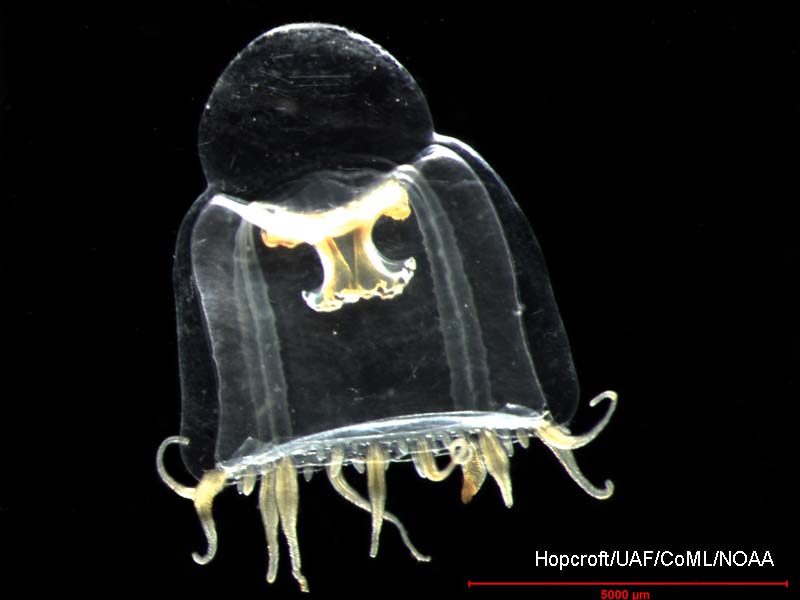
The last one, and the largest I believe is a Lion's Mane (Cyanea capillata), although I really am not sure. I understood that in general they are larger, and can indeed reach a diameter of over seven feet in Arctic Waters. The largest recorded specimen had tentacles that were 120 feet long (that's longer than a Blue Whale folks). Both of these photos are cropped from other pictures. It is a beautiful creature, with apparently a painful sting.
Also in the mix were some Copepods and Amphipods. You can see a couple of unusual (well to me anyway) amphipods inside the Pergonimus jellyfish in the above photo. I assumed that they were prey of the jelly, but they are much more interesting then that. A little while later the large one was swimming freely and I thought it had escaped.
Their most prominent feature are large bulgy eyes, and when I searched for them I found that they are from the henus Hyperia, the Big-eyed Amphipods. It turns out they are parasites of the jellies. They consume some of the Jellyfish's prey, but also some of the Jellyfish itself, primarily the gonads and tentacles. Eggs are laid in the jellyfish and the juveniles spend all the time in or on the jellyfish.
Adults are free swimming and come and go from the creature. This is my best photo of the Big-eyed Amphipod but unfortunately it isn't very good. You can make out the large bulgy eyes though.
Comments
5 responses
Okay curiousity has me wondering—why were you collecting the jelly fish?
Sarah
Hi Sarah, the answer is contained within your question. Curiosity.
We were having a close look at them, we took them to show others, and returned them to water. Sometimes, wondering about the small things, and taking the opportunity to have a close look at them, reveals things. I’m not sure what Travis learned, apart from lessons in structure and movement of the small things, and the beauty in them. But I would otherwise probably never have known that Big-eyed Amphipods existed, or that they eat jelly fish gonads, or that Lion’s Mane jellyfish grow larger (well longer) than the animal I thought was the longest in the world.
Thanks Clare. Do you think I can see jellyfish in Arivat? That would be a very cool thing to do one day…hunt jellyfish for curiousity.
They are apparently common in the Arctic ocean, so I would assume that includes Hudson Bay. We found we could find them easily on calm days.
This seems to be a very good site for seeing what biodiversity there is in the Arctic Ocean.
http://www.arcodiv.org